Short answer: a microchip should have one active record, held by the database the registered keeper chose. No database, including us, should move or delete that record because a different company says the keeper agreed. We have to hear it from the keeper.
"Pet Database can do it, so why can't you?"
We get this question a lot, from owners, breeders and rescues It’s frustrating because in reality they’re putting animals at risk and causing confusion for pet owners.
To add to this we’re receiving a growing number of transfer requests. A big part of the reason is cost. Two of the UK’s largest databases now charge owners every year:
- Petlog plans cost £15 or £39 a year, and you need a plan to update your details. A transfer of keepership costs £39.
- Identi plans cost £15 to £39 a year, with keeping your contact details up to date listed as a paid Base+ feature. A transfer of keepership costs £39.
Faced with that, it’s no surprise owners look around. On MyPet, updating your details is included, and a transfer from another database is a one-off £12, or free on MyPet Protected and MyPet Pampered. So when another database promises to move you for nothing, with no forms and no waiting, we understand why it appeals.
Pet Database tells owners that a microchip record “is not locked to the database it started on”. It says you can register the same chip with any Defra-compliant database without the original database’s permission, then “close the old record” separately. It also offers to contact your current database on your behalf, with your consent, to arrange the transfer.
It sounds simple. In practice it often means one chip ends up with two live records, and the owner gets stuck in the middle. Pet Database regularly sends us automated “transfer requests” on an owner’s behalf. On every occasion, we’ve politely let them know we can’t do anything until we hear from the keeper on our record. We also hear from owners who can’t get a duplicate removed, or can’t register their pet with us because of one.
So here’s what’s actually going on, and why we work the way we do.
What happens when a chip is registered twice
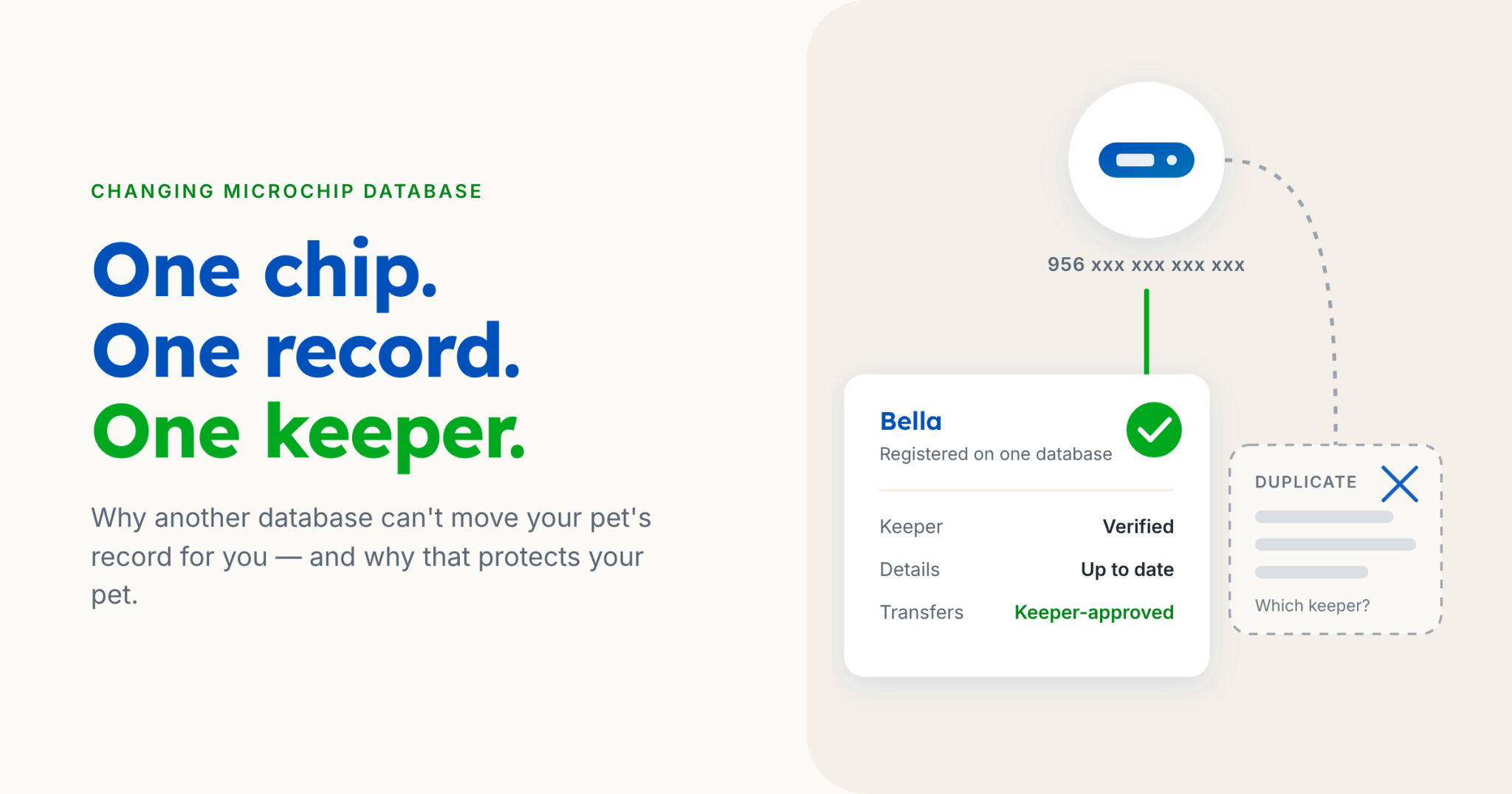
Registering a chip on a second database doesn’t move the record. It creates a new one. The original record stays live, with whoever was on it before, until the keeper on that record asks for it to be closed.
That leaves two “truths” about the same pet:
- Two sets of keeper details. One may be current, one may be years out of date. In one case we handled, three pets were on both databases under a former keeper, and all three had since been rehomed.
- No clear answer for the person scanning. UK databases share which chip numbers they hold, so a vet, warden or rescue searching a number is pointed to the database that has it. When two databases both hold it, the finder has to work out which keeper is real, at the moment it matters most.
- A slower reunion. Every phone call to the wrong keeper, and every “which one is right?” check, is time your pet spends away from home.
- Locked-out owners. Updates can stall while the chip sits on two systems. We’ve had new owners unable to register their puppy with us because someone had started, but never finished, a registration elsewhere.
This is why our system only allows one active registration per chip. We’d rather tell you “not yet” than create a second record that could send a finder to the wrong door.
Defra agrees. In its response to the cat and dog microchipping consultation, the government committed that the next legislation will ban duplicate registrations: “We will require database operators not to create duplicate registrations.” It also expects databases to release a record within 14 days of a request in most cases.
Who gets caught out
Most people asking to switch database are exactly who they say they are. The safeguards aren’t there to slow them down. They’re there for the times the person asking isn’t the keeper, or the keeper doesn’t know it’s happening.
From our own transfer requests (details changed to protect the people involved):
- A free tag that became a duplicate. An owner signed up elsewhere for a free QR tag. Her dog’s chip was registered there instantly, while it was still live with us. She decided to stay with us, but had no way to remove the second record. Six weeks later it was still there.
- A rescue up against a deadline. A charity needed a dog’s record released before a fixed rehoming date. It waited 13 days for a reply, and was sorted only days before the move.
- The keeper on the record wasn’t the one asking. In one transfer request we received, the keeper on our record was the breeder. The request had come from someone else. When we contacted the breeder, they needed time to check before agreeing.
And the cases nobody wants to imagine. We’re not the only database worried about this. Telling the public a record can be moved without contacting the existing database first opens the door to:
- Stolen pets. Pet Database registers a chip straight away, without checking with the database it’s already on. So someone who has stolen your pet could register it there in their own name, with no checks. Your record stays live where it is, and your pet ends up on two databases: one in your name, one in theirs. A vet or warden scanning the chip could be pointed to either.
- Domestic abuse and coercive control. Pets are sometimes used to control a partner. A record changed without the registered keeper knowing can be used to take a pet, hide where it is, or undercut someone’s claim to it.
- Genuine ownership disputes. Separations, family disagreements, private sales gone wrong. These need evidence and contact with the registered keeper, not a form filled in by one side.
A microchip record is often the strongest evidence a keeper has. It shouldn’t be possible to rewrite it from the outside.
Why another database can't act on your behalf
When a request reaches us from another database saying “the keeper has authorised us to act for them”, we can’t action it. That’s not us being awkward. It comes down to three things.
1. The law deals with the keeper, not a middleman. Under the Microchipping of Cats and Dogs (England) Regulations 2023, it’s the keeper’s job to record their details. When a pet changes hands, the new keeper records their details with the database the pet is already registered on. Every compliant database must also have a system for identifying keepers when they ask about a pet on that database. An email from another company is not the keeper, and we can’t identify anyone through it.
2. Your details are yours, and we protect them. We hold your name, address and phone number because you gave them to us. We only change or delete them on your instructions, once we’re sure it’s you. These automated requests have asked us to confirm whether the keeper details they hold “match those on your database”. Answering would mean telling a third party who’s on your pet’s record, and we won’t do that.
3. If we accepted it for them, we’d have to accept it for anyone. A rule that lets another company close your record on your behalf is a rule that lets anyone who fills in that company’s form close your record. That’s exactly the risk a microchip record is meant to protect against.
So whatever a request from another database says, we can’t act on it. We have to hear from the keeper on our record.
So why don't we just do what they do?
Because we won’t register a chip that’s already live elsewhere. And we won’t ask another database to delete a record on the strength of our say-so. Both would make it easier for you to switch to us. Neither is good for your pet.
It’s your choice where your pet is registered. We just want there to be one record, and for it to be right.
How to move your pet's record the right way
Switching database is your right. MyPet is a member of AMDO, the Association of Microchip Database Operators, and we follow AMDO’s defined change of database process. Every member database works the same way, so your request is handled properly at both ends.
Moving your pet to MyPet
- Check where the chip is registered now with our microchip search.
- Contact your current database and tell them you’re moving to MyPet. Let them know they’ll need to reach out to us to confirm the change. Our support article has an email template you can copy, plus contact details for each UK database.
- Your current database checks you’re the keeper on its record, then contacts us directly.
- We complete your registration and your old record is closed. A transfer is a one-off £12, or free on MyPet Protected and MyPet Pampered.
Why we do it this way
We know this takes a little longer than registering instantly. But it means:
- your pet is only ever registered once
- we’re sure the request is genuine and comes from the real keeper
- fraud, and stolen pets being registered in someone else’s name, become much harder.
Taking on a pet from someone else
The new keeper records their details on the database the pet is already on. On MyPet, the previous keeper approves the transfer, so a record can’t change hands without them knowing. No need to start again somewhere else.
Already registered twice?
- Decide which database you want to keep.
- Contact the other one yourself and ask for its record to be archived. Ask for written confirmation.
- If the record you want closed is with us, get in touch and we’ll verify you and close it.
- Check your pet’s chip again a week later to make sure only one record comes back.
If you’re stuck in the middle, get in touch. A real person will help you work out where your pet is registered and what to do next.
One chip, one record, one keeper
A microchip only works if the person scanning it reaches the right person, first time. That’s why we deal with keepers directly, and why we’ll never register a chip that’s already live somewhere else.
Register your pet on the MyPet Database. Defra-compliant, trusted since 2019, and free for owners on a MyPet microchip.